

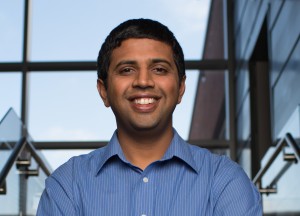
Kingland Professor of Data Analytics
Professor, Dept. of Electrical and Computer Engineering
and (by courtesy), Dept. of Computer Science
Iowa State University
I received a B.Tech. in Computer Science from the Indian Institute of Technology, Madras in 1996, and a Ph.D. in Computer Science from Brown University in 2002. During 2009 and 2010, I worked as a Consulting Member of Technical Staff at Oracle Corporation.In the summer of 2013, I was a visiting researcher at Microsoft Research, Cambridge.
Our group’s research is centered on the foundations of large-scale data analysis, especially streaming and parallel algorithms applied to large-scale data. I am also interested in applications of data analytics to areas such as security. Our research has been funded by grants from the National Science Foundation (NSF), Defense Advanced Projects Research Agency (DARPA), IBM Corporation, and Northrop Grumman Corporation. I have received the IBM Faculty Award twice, in 2014 and in 2013, and the Warren B. Boast Undergraduate Teaching Award in 2012.
Links
- Material for our tutorial “Subgraph counting: the methods behind the madness”, delivered at the Web Conference, May 2019
- List of Publications
- CV with details of Publications, Funding, etc
- Graph Stream Processing, funded by the NSF
- Detecting Space and Time Complexity Attacks within Programs for Cybersecurity, funded by DARPA
- Publication list on DBLP
- LinkedIn Profile
- Google Scholar Page
Current and Recent Professional Service
Program committee member for the following conferences.
- ICDE 2019: IEEE International Conference on Data Engineering
- The Web Conference 2019 (formerly WWW), Social Network Analysis and Graph Algorithms Track
- ICDE 2019: IEEE International Conference on Data Engineering
- PPoPP 2019: Principles and Practice of Parallel Programming – Extended Review Committee
- PODS 2018: ACM Symposium on Principles of Database Systems
- (Review Board) of VLDB 2018, International Conference on Very Large Databases
- ICDT 2017, International Conference on Database Theory
Contact Information
| Office | Room 3227, Coover Hall, Iowa State University |
| Mailing Address | 2215, Coover Hall Iowa State University 2520 Osborn Dr. Ames IA 50011-1046 |
| snt@iastate.edu | |
| Voice | +1-515-294-3546 |
| Fax | +1-515-294-3637 |
List of Publications
2019
- Parallel Streaming Random Sampling
Kanat Tangwongsan, Srikanta Tirthapura
Euro-par Conference 2019 - Incremental Maintenance of Maximal Cliques in a Dynamic Graph
Apurba Das, Michael Svendsen, Srikanta Tirthapura
The VLDB Journal (2019). https://doi.org/10.1007/s00778-019-00540-5 - Weighted Reservoir Sampling from Distributed Streams
Rajesh Jayaram, Gokarna Sharma, Srikanta Tirthapura, and David Woodruff
to appear in the ACM Symposium on Principles of Database Systems (PODS) 2019 - Stratified Random Sampling from Streaming and Stored Data
Trong Nguyen, Ming-Hung Shih, Divesh Srivastava, Srikanta Tirthapura and Bojian Xu
accepted to International Conference on Extending Database Technology (EDBT) 2019
2018
- Enumerating Top-k Quasi Cliques
Seyed-Vahid Sanei-Mehri,Apurba Das, Srikanta Tirthapura
accepted to IEEE Bigdata 2018
also available at https://arxiv.org/abs/1808.09531 - Variance-Reduced Stochastic Gradient Descent on Streaming Data
Ellango Jothimurugesan, Ashraf Tahmasbi, Phillip B. Gibbons, Srikanta Tirthapura
accepted to Thirty-second Conference on Neural Information Processing Systems (NIPS) 2018 - Shared-Memory Parallel Maximal Clique Enumeration
Apurba Das, Seyed-Vahid Sanei-Mehri, Srikanta Tirthapura
Accepted to appear in 25th IEEE International Conference on High Performance Computing, Data, and Analytics (HiPC) 2018
CoRR abs/1807.09417
Also see https://arxiv.org/abs/1807.09417 - Butterfly Counting in Bipartite Networks
Seyed-Vahid Sanei-Mehri, Ahmet Erdem Sariyuce, Srikanta Tirthapura
ACM International Conference on Knowledge Discovery and Data Mining (KDD), 2150-2159, 2018 - HYDRA: A Dynamic Big Data Regenerator, (demonstration paper)
Anupam Sanghi, Raghav Sood, Dharmendra Singh, Jayant Haritsa, Srikanta Tirthapura,
Proc. VLDB Endowment (PVLDB), 1974-1977, 2018 - V2V: Vector Embedding of a Graph and Applications
Trong Nguyen and Srikanta Tirthapura
Second Workshop on the Intersection of Graph Algorithms and Machine Learning (GraML)
IPDPS Workshops, 1175-1183, 2018 - Learning Graphical Models from a Distributed Stream
Yu Zhang, Srikanta Tirthapura, and Graham Cormode
Proc. IEEE International Conference on Data Engineering (ICDE) 2018 - Onion Curve: A Space Filling Curve with Near-Optimal Clustering
Pan Xu, Cuong Nguyen, and Srikanta Tirthapura
Proc. IEEE International Conference on Data Engineering (ICDE) 2018 - Incremental Maintenance of Maximal Cliques in a Dynamic Bipartite Graph
Apurba Das and Srikanta Tirthapura
IEEE Transactions on Multi-Scale Computing Systems 4(3), 231–242, 2018. DOI 10.1109/TMSCS.2018.2802920 - Scalable and Dynamic Regeneration of Big Data Volumes
Anupam Sanghi, Raghav Sood, Jayant Haritsa, Srikanta Tirthapura
Proc. 21st International Conference on Extending Database Technology (EDBT), 301-312, 2018 - Work-Efficient Parallel Union-Find
Natcha Simsiri, Kanat Tangwongsan, Srikanta Tirthapura, and Kun-Lung Wu
Concurrency and Computation Practice and Experience 2018;30:e4333. https://doi.org/10.1002/cpe.4333
2017
- Enumerating Maximal Bicliques from a Large Graph using MapReduce
Arko Mukherjee and Srikanta Tirthapura
IEEE Transactions on Services Computing (TSC), 10(5): 771-784, 2017 - Streaming Algorithms for k-Means Clustering with Fast Queries
Yu Zhang, Kanat Tangwongsan, Srikanta Tirthapura
Proc. IEEE International Conference on Data Engineering (ICDE), pages 449-460, 2017 - Enumeration of Maximal Cliques from an Uncertain Graph
Arko Mukherjee, Pan Xu, and Srikanta Tirthapura
IEEE Transactions on Knowledge and Data Engineering (TKDE), 29(3): 543-555, 2017
(Special Issue for Best Papers from ICDE 2015) - Detecting Insider Threats using RADISH, a System for Real-time Anomaly Detection in Heterogeneous Data Streams
Brock Bose, Bhargav Avasarala, Yung-Yu Chung, Srikanta Tirthapura, Donald Steiner
IEEE Systems Journal, 11(2), 471-482, 2017 (Special Issue on Insider Threat)
2016
-
Estimating Quantiles from the Union of Historical and Streaming Data
(talk slides from VLDB 2017 in pdf)
Sneha A. Singh, Divesh Srivastava, and Srikanta Tirthapura
Proceedings of the VLDB Endowment (PVLDB) 10(4): 433-444, 2016 - Identifying Correlated Heavy-Hitters in a Two-Dimensional Data Stream
Bibudh Lahiri, Arko Mukherjee, Srikanta Tirthapura
Data Mining and Knowledge Discovery, 30(4), 797-818, 2016 - A Simple Message-Optimal Algorithm for Random Sampling from a Distributed Stream
Yung-Yu Chung, Srikanta Tirthapura, and David Woodruff
IEEE Transactions on Knowledge and Data Engineering (TKDE), 28(6), 1356-1368, 2016 - Work-Efficient Parallel and Incremental Graph Connectivity
Natcha Simsiri, Kanat Tangwongsan, Srikanta Tirthapura, and Kun-Lung Wu
Accepted to appear in Euro-Par 2016 Conference
A full version Arxiv http://arxiv.org/pdf/1602.05232v1.pdf - Change-Sensitive Algorithms for Maintaining Maximal Cliques in a Dynamic Graph
Apurba Das, Michael Svendsen, and Srikanta Tirthapura
Arxiv http://arxiv.org/abs/1601.06311 - Space-Efficient Estimation of Statistics over Sub-Sampled Streams
Andrew McGregor, A. Pavan, Srikanta Tirthapura and David Woodruff
Algorithmica 74(2), pages 787-811, 2016
http://link.springer.com/article/10.1007/s00453-015-9974-0
2015
- Mining Maximal Cliques from a Large Graph using MapReduce: Tackling Highly Uneven Subproblem Sizes
Michael Svendsen, Arko Mukherjee, Srikanta Tirthapura (bibtex)
Journal Par. and Distributed Computing (Special Issue for Big Data), 79: pages 104-114, 2015
http://www.sciencedirect.com/science/article/pii/S0743731514001531
- An Evaluation of Streaming Algorithms for Distinct Counting over a Sliding Window
Sneha Aman Singh, Srikanta Tirthapura
Frontiers in ICT, section Big Data, 2(23), 2015, http://dx.doi.org/10.3389/fict.2015.00023 - A General Method for Estimating Correlated Aggregates on a Data Stream (bibtex)
Srikanta Tirthapura, David Woodruff
Algorithmica 73(2): pages 235-260, 2015
http://www.springerlink.com/openurl.asp?genre=article&id=doi:10.1007/s00778-013-0340-z - Distinct Random Sampling from a Distributed Stream (slides in pdf) (bibtex)
Yung-Yu Chung and Srikanta Tirthapura
Proc. IEEE International Parallel and Distributed Processing Symposium (IPDPS) 2015 - Mining Maximal Cliques from an Uncertain Graph (slides in pdf) (bibtex)
Arko Mukherjee, Pan Xu, and Srikanta Tirthapura
Proc. IEEE International Conference on Data Engineering (ICDE) 2015
Invited to a special issue of the journal IEEE TKDE for the best papers from ICDE 2015.
2014
- Monitoring Persistent Items in the Union of Distributed Streams (bibtex)
Sneha Aman Singh, Srikanta Tirthapura
Journal of Parallel and Distributed Computing, 74(11): pages 3115—3127, 2014 - Optimality of Clustering Properties of Space Filling Curves (bibtex)
Pan Xu, Srikanta Tirthapura
ACM Transactions on Database Systems 39(2):10, 2014 - Space-Efficient Tracking of Persistent Items in a Massive Data Stream (bibtex)
Bibudh Lahiri, Jaideep Chandrashekar, Srikanta Tirthapura
Statistical Analysis and Data Mining 7(1): pages 70-92, 2014 - Dense Subgraph Maintenance under Streaming Edge Weight Updates for Real-time Story Identification (bibtex)
Albert Angel, Nick Koudas, Nikos Sarkas, Divesh Srivastava, Michael Svendsen, Srikanta Tirthapura
The VLDB Journal 23(2): 175-199, 2014 - Sparse Covers for Planar Graphs and Graphs that Exclude a Fixed Minor (bibtex)
Costas Busch, Ryan LaFortune, Srikanta Tirthapura
Algorithmica 69(3): pages 658-684, 2014
http://link.springer.com/article/10.1007/s00453-013-9757-4 - EvoMiner: Frequent Subtree Mining in Phylogenetic Databases (bibtex)
Akshay Deepak, David Fernández-Baca, Srikanta Tirthapura, Michael J. Sanderson, Michelle M. McMahon
Knowledge and Information Systems 41(3), pages 559-590, 2014
http://www.springerlink.com/openurl.asp?genre=article&id=doi:10.1007/s10115-013-0676-0 - Enumerating Maximal Bicliques from a Large Graph using MapReduce (bibtex)
Arko Mukherjee and Srikanta Tirthapura
Proc. IEEE International Congress on BigData, 2014, pages 707-716 - Parallel Streaming Frequency-Based Aggregates (bibtex)
Kanat Tangwongsan, Srikanta Tirthapura, Kun-Lung Wu
Proc. ACM Symposium on Parallel Algorithms and Architectures, (SPAA) 2014
2013
- Counting and Sampling Triangles from a Graph Stream (bibtex)
A. Pavan, Kanat Tangwongsan, Srikanta Tirthapura, Kun-Lung Wu
In Proc. VLDB Endowment (PVLDB) 6(14): 1870-1881, 2013 - Parallel Triangle Counting in Massive Streaming Graphs (bibtex)
Kanat Tangwongsan, A. Pavan, Srikanta Tirthapura
Proc. ACM Conference on Information and Knowledge Management (CIKM) 2013
The full version is available at http://arxiv.org/abs/1308.2166.
2012
- Approximate Covering Detection among Content-Based Subscriptions Using Space Filling Curves (bibtex)
Zhenhui Shen, Srikanta Tirthapura
Journal of Parallel and Distributed Computing 72(12): pages 1591-1602, 2012
http://dx.doi.org/10.1016/j.jpdc.2012.09.002 - Computational characterization of bulk heterojunction nanomorphology
O. Wodo, S. Tirthapura, S. Chaudhary, B. Ganapathysubramanian
Journal of Applied Physics 112, 064316, 2012 - A novel graph based formulation for characterizing morphology with application to Organic Solar Cells
O. Wodo, S. Tirthapura, S. Chaudhary, B. Ganapathysubramanian
Organic Electronics, 13(6), pages 1105-1113, 2012 - On Optimality of Clustering Through a Space Filling Curve (slides) (bibtex)
Pan Xu and Srikanta Tirthapura
Proc. ACM Symposium on Principles of Database Systems (PODS 2012) - Rectangle-Efficient Aggregation in Spatial Data Streams (slides) (bibtex)
Srikanta Tirthapura and David Woodruff
Proc. ACM Symposium on Principles of Database Systems (PODS 2012) - Space-Efficient Estimation of Statistics over Sub-Sampled Streams (slides) (bibtex)
Andrew McGregor, A. Pavan, Srikanta Tirthapura and David Woodruff
Proc. ACM Symposium on Principles of Database Systems (PODS 2012) - A Lower Bound on Proximity Preservation by Space Filling Curves (bibtex)
Pan Xu and Srikanta Tirthapura
Proc. 26th IEEE International Parallel & Distributed Processing Symposium (IPDPS 2012) - A General Method for Estimating Correlated Aggregates over a Data Stream (slides) (bibtex)
Srikanta Tirthapura and David Woodruff
Proc. 28th IEEE International Conference on Data Engineering (ICDE 2012)
2011
- Optimal Random Sampling from Distributed Streams Revisited (talk slides in pdf) (bibtex)
Srikanta Tirthapura and David Woodruff
Proc. 25th International Symposium on Distributed Computing (DISC 2011) - Space-efficient Tracking of Persistent Items in a Massive Data Stream (bibtex)
Bibudh Lahiri, Jaideep Chandrashekar, and Srikanta Tirthapura
Proc. 5th ACM International Conference on Distributed Event-Based Systems (DEBS 2011)
see updated journal version above
2010
- Identifying Frequent Items in a Network using Gossip (bibtex)
Bibudh Lahiri and Srikanta Tirthapura
Journal of Parallel and Distributed Computing 70(12), pages 1241-1253, 2010
http://dx.doi.org/10.1016/j.jpdc.2010.07.006 - Concurrent Counting is Harder than Queuing (bibtex)
Costas Busch and Srikanta Tirthapura
Theoretical Computer Science 411(43), pages 3823-3833, 2010
http://dx.doi.org/10.1016/j.tcs.2010.07.002 - Delay, cost and infrastructure tradeoff of epidemic routing in mobile sensor networks. (bibtex)
Shan Zhou, Lei Ying, Srikanta Tirthapura
Proc. 6th International Wireless Communications and Mobile Computing Conference (IWCMC) 2010
2009
- Time-decayed Correlated Aggregates over Data Streams (bibtex)
Graham Cormode, Srikanta Tirthapura and Bojian Xu
Statistical Analysis and Data Mining
Special issue for the best papers in SDM 2009
http://dx.doi.org/10.1002/sam.10053 - Time-Decaying Sketches for Robust Aggregation of Sensor Data (bibtex)
Graham Cormode, Srikanta Tirthapura and Bojian Xu
SIAM Journal on Computing, 39(4), pp. 1309-1339, 2009
http://link.aip.org/link/?SMJ/39/1309 - Finding correlated heavy-hitters over data streams (see updated journal version) (bibtex)
Bibudh Lahiri, Srikanta Tirthapura
Proc. International Performance Computing and Communications Conference (IPCCC) 2009 - Wireless Sensor Deployment for 3D Coverage with Constraints
Tycho Andersen and Srikanta Tirthapura
Proc. International Symposium on Networked Sensing Systems, 2009 (INSS) - Time-decayed Correlated Aggregates over Data Streams (see updated journal version) (bibtex)
Graham Cormode, Srikanta Tirthapura and Bojian Xu
Proc. 9th SIAM International Conference on Data Mining (SDM), 2009, 12 pages
Selected as one of the 7 best papers out of 351 conference submissions
and invited to a special issue of the journal “Statistical Analysis and Data Mining”.
2008
- Sketching Asynchronous Streams over Sliding Windows (bibtex)
Bojian Xu, Srikanta Tirthapura, Costas Busch
Distributed Computing 20(5), pages 359–374, 2008
http://www.springerlink.com/content/4k517jr6x60h1l72/ - Computing Frequent Elements using Gossip (see updated journal version) (bibtex)
Bibudh Lahiri, Srikanta Tirthapura
Proc. International Colloquium on Structural Information and Communication Complexity (SIROCCO), 2008 - Time-Decaying Aggregates in Out-of-order Streams (bibtex)
Graham Cormode, Flip Korn, Srikanta Tirthapura
Proc. ACM Symposium on Principles of Database Systems (PODS) 2008 - Exponentially Decayed Aggregates on Data Streams (bibtex)
Graham Cormode, Flip Korn, Srikanta Tirthapura
Proc. IEEE International Conference on Data Engineering (ICDE) 2008
2007
- Range-Efficient Counting of Distinct Elements in a Massive Data Stream (bibtex)
A. Pavan and Srikanta Tirthapura
SIAM Journal on Computing 37(2), Pages 359–379, May 2007
http://dx.doi.org/10.1137/050643672 - Improved Sparse Covers for Graphs Excluding a Fixed Minor (see updated journal version) (bibtex)
Costas Busch and Ryan LaFortune and Srikanta Tirthapura
Proc. ACM Symposium on Principles of Distributed Computing (PODC) 2007 - Time-Decaying Sketches for Sensor Data Aggregation (see updated journal version) (bibtex)
Graham Cormode and Srikanta Tirthapura and Bojian Xu
Proc. ACM Symposium on Principles of Distributed Computing (PODC) 2007 - Approximate Covering Detection among Content-Based Subscriptions using Space Filling Curves (see updated journal version) (talk slides in pdf) (bibtex)
Zhenhui Shen and Srikanta Tirthapura
Proc. IEEE International Conference on Distributed Computing Systems (ICDCS) 2007 - A Deterministic Algorithm for Summarizing Asynchronous Streams over Sliding Windows (talk slides in pdf)(bibtex)
Costas Busch and Srikanta Tirthapura
Proc. International Symposium on Theoretical Aspects of Computer Science (STACS) 2007
2006
- Dynamic Analysis of the Arrow Distributed Protocol (bibtex)
Maurice Herlihy, Fabian Kuhn, Roger Wattenhofer and Srikanta Tirthapura
Theory of Computing Systems 39(6), pages 875–901, 2006
http://dx.doi.org/10.1007/s00224-006-1251-9 - Self-Stabilizing Distributed Queuing (bibtex)
Srikanta Tirthapura and Maurice Herlihy
IEEE Transactions on Parallel and Distributed Systems 17(7), pages 646–655, July 2006
http://doi.ieeecomputersociety.org/10.1109/TPDS.2006.94 - Self Stabilizing Smoothing and Balancing Networks (bibtex)
Maurice Herlihy and Srikanta Tirthapura
Distributed Computing 18(5), pages 345–357, 2006
http://www.springerlink.com/content/f6226v603k54g672/ - Randomized Smoothing Networks (bibtex)
Maurice Herlihy and Srikanta Tirthapura
Journal of Parallel and Distributed Computing 66(5), May 2006
(special issue for the best papers from IPDPS 2004)
http://dx.doi.org/10.1016/j.jpdc.2005.06.009 - Sketching Asynchronous Streams over Sliding Windows (see updated journal version) (bibtex)
Srikanta Tirthapura and Bojian Xu and Costas Busch
Proc. ACM Conference on Principles of Distributed Computing (PODC) 2006 - Faster Event Forwarding in a Content-Based Publish-Subscribe System through Lookup Reuse (bibtex)
Zhenhui Shen and Srikanta Tirthapura
Proc. IEEE International Symposium on Network Computing and Applications (NCA) 2006 - A Formal Analysis of Space Filling Curves for Parallel Domain Decomposition (bibtex)
Srikanta Tirthapura and Sudip Seal and Srinivas Aluru
Proc. IEEE International Conference on Parallel Processing (ICPP) 2006 - Concurrent Counting is Harder than Queuing (see updated journal version) (talk slides in pdf) (bibtex)
Srikanta Tirthapura and Costas Busch
Proc. IEEE International Parallel and Distributed Processing Symposium (IPDPS) 2006
2005
- Analysis of Link Reversal Routing Algorithms (bibtex)
Costas Busch and Srikanta Tirthapura
SIAM Journal on Computing 35(2), pages 305–326, 2005
http://epubs.siam.org/SICOMP/volume-35/art_44359.html - Adaptive Counting Networks (talk slides in ppt pdf) (bibtex)
Srikanta Tirthapura
Proc. IEEE International Conference on Distributed Computing Systems (ICDCS) 2005 - Range-efficient Computation of F0 over massive data streams (see updated journal version) (slides in ppt pdf) (bibtex)
A.Pavan and Srikanta Tirthapura
Proc. IEEE International Conference on Data Engineering (ICDE), 2005, pages 32-43 - Indexing for Subscription Covering in Publish-Subscribe Systems (bibtex)
Zhenhui Shen and Srikanta Tirthapura and Srinivas Aluru
Proc. ISCA 18th International Conference on Parallel and Distributed Computing Systems (PDCS), 2005
2004
- Distributed Streams Algorithms for Sliding Windows
Phillip Gibbons and Srikanta Tirthapura
Theory of Computing Systems 37, pages 457–478, 2004
(special issue for the best papers from SPAA 2002)
http://www.springerlink.com/content/fyj1f7mxk6tuhnw3/ - Randomized Smoothing Networks (see updated journal version) (talk slides in ppt, pdf) (bibtex)
Maurice Herlihy and Srikanta Tirthapura
Proc. IEEE International Parallel and Distributed Processing Symposium (IPDPS) 2004
Selected one of the best papers in the conference and invited to a special issue of the Journal of Parallel and Distributed Computing - Self-stabilizing Routing in Publish-Subscribe Networks
Zhenhui Shen and Srikanta Tirthapura
Proc. International Workshop on Distributed Event Based Systems (DEBS), May 2004
2003
- Analysis of Link Reversal Routing Algorithms for Mobile Ad Hoc Networks (bibtex)
Costas Busch and Srikanth Surapaneni and Srikanta Tirthapura
Proc. ACM Symposium on Parallel Algorithms and Architectures (SPAA), 2003
Also see journal version (in SICOMP) - Self Stabilizing Smoothing and Balancing Networks (talk slides in ppt, pdf) (bibtex)
Maurice Herlihy and Srikanta Tirthapura
Proc. IEEE International Conference on Distributed Computing Systems (ICDCS), 2003
See updated journal version (in Distributed Computing)
2002
- Distributed Streams Algorithms for Sliding Windows (bibtex)
Phillip Gibbons and Srikanta Tirthapura
Proc. ACM Symposium on Parallel Algorithms and Architectures (SPAA), 2002
Selected one of the best papers in the conference and invited to a special issue of “Theory of Computing Systems”
See updated journal version (in TOCS)
2001
- Ordered Multicast and Distributed Swap (bibtex)
Maurice Herlihy and Srikanta Tirthapura and Roger Wattenhofer
Operating Systems Review 35(1), 2001, pages 85-96. - Self Stabilizing Distributed Queuing (bibtex)
Maurice Herlihy and Srikanta Tirthapura
Proc. International Symposium on Distributed Computing (DISC), 2001
See updated journal version (in IEEE TPDS) - Competitive Concurrent Distributed Queuing (bibtex)
Maurice Herlihy and Srikanta Tirthapura and Roger Wattenhofer
Proc. ACM Symposium on Principles of Distributed Computing (PODC) 2001 - Estimating simple functions on the union of data streams (bibtex)
Phillip Gibbons and Srikanta Tirthapura
Proc. ACM Symposium on Parallel Algorithms and Architectures (SPAA), 2001, pages 281–291
2000
- A Tree-edit-distance algorithm for comparing simple, closed shapes (talk slides in pdf) (bibtex)
Philip Klein and Srikanta Tirthapura and Daniel Sharvit and Ben Kimia
Proc. ACM-SIAM Symposium on Discrete Algorithms (SODA) 2000 pages 696-704
1998
- Indexing based on edit-distance matching of shape graphs
Srikanta Tirthapura and Philip Klein and Daniel Sharvit and Ben Kimia
Proc. SPIE International Symposium on Voice, Video, and Data Communications, 1998, pages 25-36
1997
- Banyan: A Language for Scalable Parallel Programming on Loosely Coupled Distributed Systems
Srikanta Tirthapura and M.V.Sudha Kiran and D.Janaki Ram
High Performance Computing Asia 1997, Seoul, South Korea
Patents
- Mark Moir, David Dice, Srikanta Tirthapura, “System and Method for Optimizing a Code Section by Forcing a Code Section to be Executed Atomically”, US Patent 8,533,699, September 2013.
- Graham Cormode, Flip Korn, Srikanta Tirthapura, “Computing Time-Decayed Aggregates Under Smooth Decay Functions”, US patent 8,484,269, July 2013.
- Graham Cormode, Flip Korn, Srikanta Tirthapura, “Computing Time-Decayed Aggregates in Data Streams”, US patent 8,391,164, Mar 2013.
- Srikanta Tirthapura, David P. Woodruff, “Random Sampling from Distributed Streams”, US patent 8,392,434, Mar 2013.
- David P. Woodruff, Srikanta Tirthapura, “Computing Correlated Aggregates Over a Data Stream”, US Patent 8,908,554, Dec 2014
Copyright Notice
The copyright for most of the above papers lie with the publishers. Please respect the publishers’ rights.